

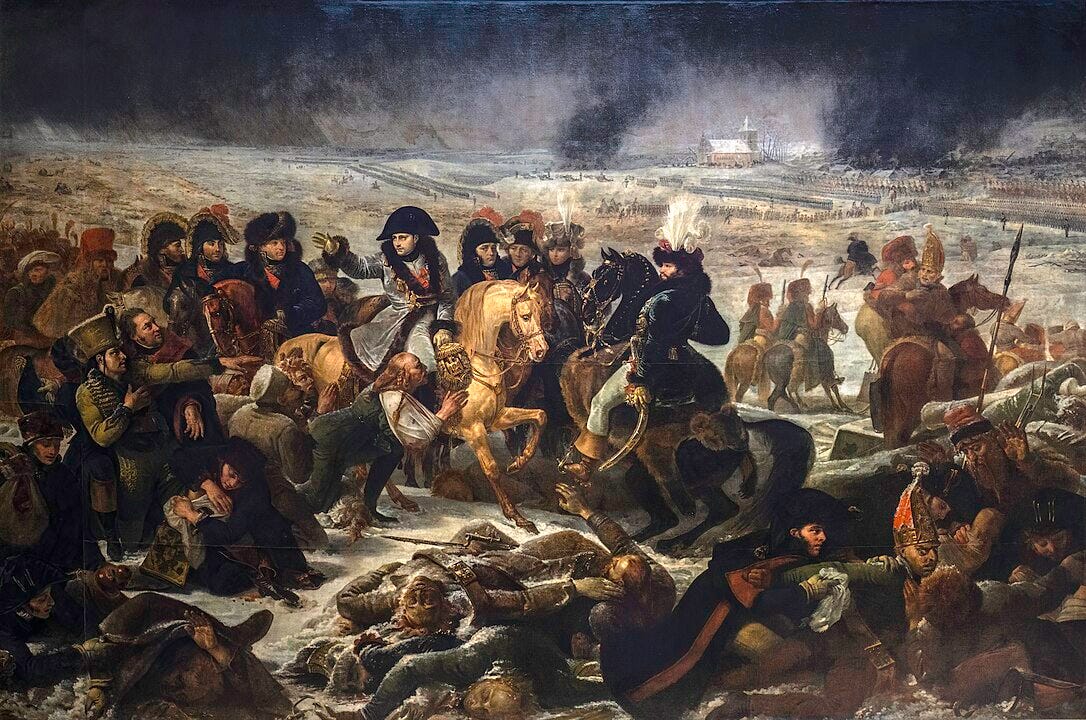
I. WWII: How Russia Treated its Wounded
Russian people suffered terribly in World War II or the Great Patriotic War. Some 19 million military and 23 million civilians died and another 46 million wounded. A Soviet soldier had a 73% chance of being killed or wounded. For Germans, it was around 62%. For the U.K. and U.S.A., it was around 6%.
The difference was partly because of terrain, with the Soviet and German forces fighting in open ground and around cities with heavy concentration of artillery fire and mine warfare.
It was also due to Russian evacuation policy. Allied troops tended to work quickly to transport wounded. The Soviet system had up to nine stages of medical evacuation. But these were just transportation, not treatment, stages. Every stage meant a lower chance of survival. Evacuation was not a high priority. Some 2.4 million soldiers were left where they fell. Forests were planted and new construction was built on top of the dead. Corpses are still found every spring.
Wounded soldiers returning home fared little better. Around 10 million Soviet soldiers suffered permanent disabilities and 5.5 million lost one or more limbs. They were not greeted as heroes. By 1948, special camps and villages were set up to remove amputees from the streets. Not only were they an eyesore for the government but many of them were openly critical of the Soviet regime. The mortality rate for these wounded climbed quickly. Statistics were hidden but one camp, the Valaam Monastery in the middle of Lake Ladoga and 30 miles from shore, saw a 30% death rate in just five years.
In another purge in 1951 “to combat antisocial, parasitic elements [and eliminate] such an intolerable phenomenon as begging” some 445,000 wounded were arrested for begging and simply disappeared. By the mid 1950s the number of disabled veterans fell from 5.5 million in 1945 to 1.3 million. The state viewed them as “an annoying burden on Soviet society” and did its best to keep them hidden and away from healthcare.
About 15% of the population were war veterans in 1945. This fell to 3% by the mid 1970s. In the U.S.A. it was 11% in 1945 and 6% in 1974. The Soviets didn’t like the wounded or disabled. It did not fit the Soviet story that the war was won single handedly by the Red Army.
II. And how does Russia Treat its Wounded in the Ukraine invasion?
Pretty much the same.
First, we must accept that Russia lies.
All the time. Even when they don’t have to. Data is often extrapolated from other sources. Here’s one way.
The Russian authorities do not publish casualty lists. But each oblast publishes, with a delay, a Register of Inheritance Cases (“registry”).
Typically, a notary registers any civilian or military death in the registry, and families have 180 days to claim an inheritance. Ninety percent of cases are registered within a week. So, if there’s a sudden drop in cases filed, it’s reasonable to assume authorities are withholding information. The state lies with such ease that no-one complains.
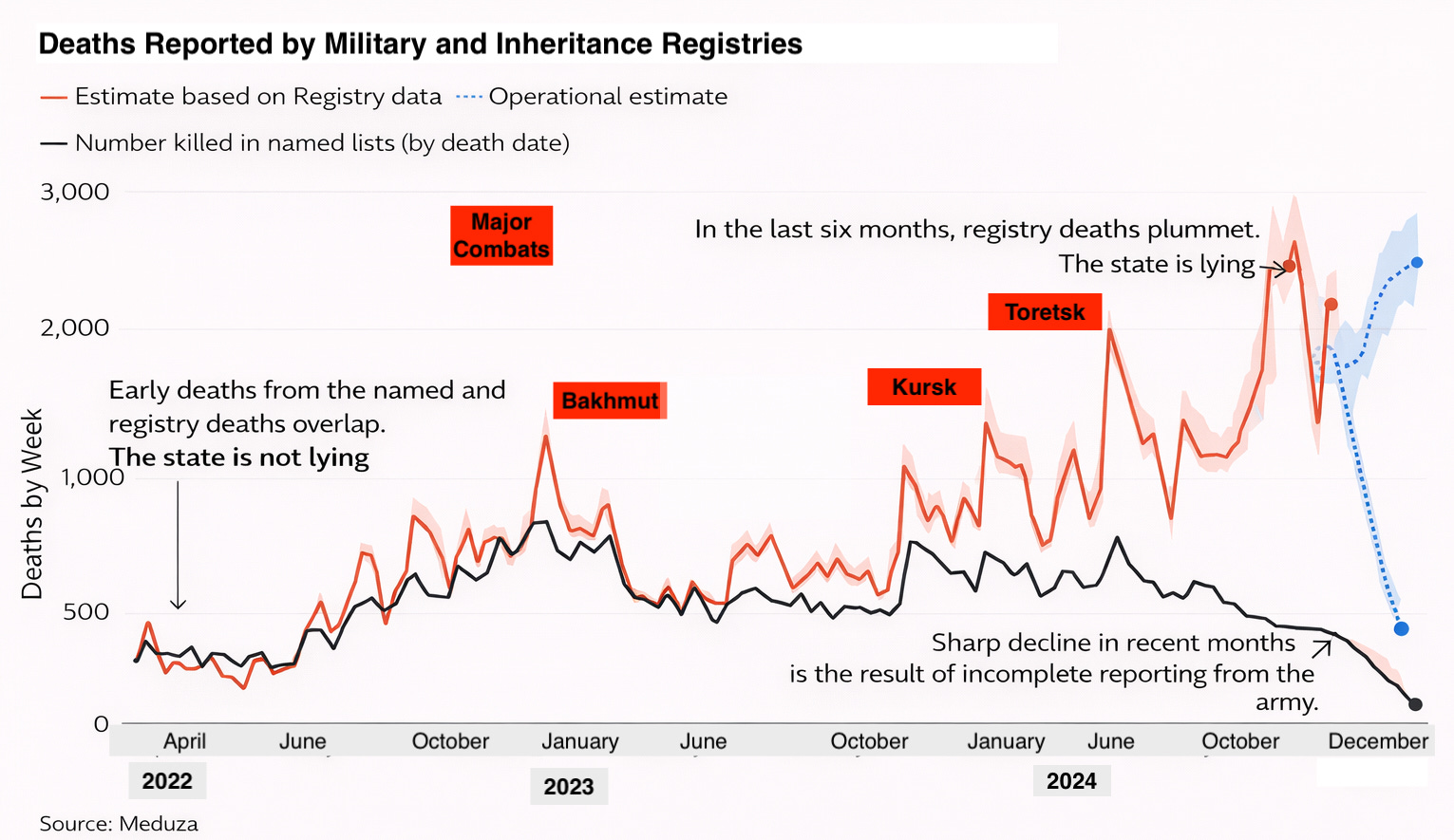
We know this by comparing deaths announced, or “named”, by the military to the deaths in the Inheritance registry. The data appeared in a leaked database earlier this year, hence the 2024 cut off.
What’s going on?
This black line shows the number of “named” deaths per week of military personnel as reported by the army. The red line shows the “registry” data of military deaths from the Inheritance Registry. For the first few months, they overlap. The military announced a death, and it showed up in the registry almost immediately. So far so normal.
In January 2023, the Battle of Bakhmut took place, and Russian casualties rose from 3,800 a week to 6,000. This is when the registry and named deaths start to separate. The Russian military was slow to report the deaths or simply didn’t bother.
The same happened in October 2023 when Ukrainian forces moved into Kursk, Russia. The Russians responded with a very costly counterattack. Again, the data diverge because the “registry “data climbed as families notified the regional governments about the deaths of family members which the military had not reported.
By late 2024, the military woke up to the fact that “named” deaths were wildly out of line with “registry” deaths. In more organized countries, the discrepancy would have alerted people that there were two reports of which one was incorrect. But it took the Russian bureaucracy a few months to figure it out. By late 2024, both the military and civilian authorities stopped publishing data, and so named and registry deaths dropped.
The upward blue line in the far right shows what “registry” deaths should be if the relationship between the named and registry deaths remained constant. The downward blue line is what they are reporting.
So, we have three numbers on the graph at the end of 2024, and one real number:
- 250: official military deaths reported
- 500: Inheritance registry deaths reported back in the oblasts
- 2,500: implied deaths based on prior reporting ratios
- 6,600: reliable reports from Ukraine authorities, the WHO, RUSI and the ISW.
Now we know the Russian reported deaths are misleading an outright lie, we can keep going.
Second, Russia’s reported numbers don’t include non-persons.
The Russians exclude soldiers from Luhansk and Donetsk from any casualty lists, because they are foreign fighters from the so-called Luhansk and Donetsk People’s Republics (LPR and DPR). Nor do they include North Koreans, Syrians and the 18,000 volunteers from over 100 countries. Nor do they include the 170,000 troops from the Storm Z battalions, which was made up of released criminals. These categories are around 250,000 to 290,000 of a fighting force of around 800,000.
Third, if they underreport deaths, they must underreport wounded.
They do.
One, if a Russian soldier returns to his unit (there are very few women front-line soldiers) in 30 days, they are not reported as injured.
Two, military doctors are encouraged to underreport injury severity. This is to hasten a return to the front where the wounded can serve in “Recovery Regiments”. These are not rear supporting troops. Many are used to retrieve gear, clothes and ammunition from active combat zones.
Three, the state is meant to compensate soldiers $1,000 for those with minor injuries, $2,200 for those with moderate injuries and $30,000 for those with severe injuries.
Before the war, a “severe” injury included any amputation of any part of the leg or arm. In 2024, any amputation is classified as a “minor” injury. So, if a soldier loses a leg, they are given compensation for a minor injury. If they want to take a chance in the private sector, they receive no further payments.
Russia being Russia, thus reneges on its commitments to the wounded and drastically under records the actual number of wounded.
If they’re wounded and not serving in a Recovery Regiment, what do they do?
Before they stopped reporting casualties, around 54% of wounded soldiers were amputees. If the ratio continued, the number of amputees is probably close to 200,000.
The state created The Defenders of the Fatherland Foundation in 2023. It’s run by Putin’s cousin. It has a budget of $28 million of which $24 million has been spent on salaries. It does a good job pretending there’s a network of support. But social media tells a very different story. Some comments:
“[the new prosthetic] it’s no use…it’s either take it or leave it. The socket is poorly made, the cheap liners are completely uncomfortable. The foot itself doesn’t match the normal size of my existing foot, so I can’t find the right shoes. I have to either get two pairs of different sizes or have them custom-made.
It’s sitting there collecting dust, but they’re asking me to film some kind of video report. Please take it back. Thanks for your support. It’s best to keep quiet about everything else.”
“Here in our rule-of-law state, it’s like this: serve and then get thrown away! How many more such fates are there—heroic soldiers, the wounded, the missing, whom the state ignores! But on TV, everything is for the military and their families! And 50,000 service members and military retirees haven’t been provided with permanent housing or military subsidies since 2016.”
“Such [wounded] patients are usually sent to the reserve, in most cases they are simply the first to attack when there are not enough people, and there they run out very quickly, depending on which direction it [the attack] is in.
Comments were turned off on the official site 12 months ago.
Some of the disabled are trained in sports. A program called “Rehabilitation through Sport” was set up and some patients were sent to Kemerova in Siberia, 2,300 miles from Moscow, to learn to ski. The program is open to wounded veterans, provided they can show their veteran’s ID. It takes a year to process a veterans’ ID. Once approved they can choose from shooting, archery, table tennis, sitting-volleyball, and powerlifting.
Super.
Neglecting the wounded has a huge social cost
Russia’s treatment of the wounded will end badly. Soldiers with PTSD returning from Bosnia reported 50% to 80% unemployment. Sixty percent of all veterans, or 380,000, from the Soviet-Afghan war in the 1980s suffered alcoholism or drug addiction. Seventy percent of soldiers returning from the two Chechen Wars, from 1994 to 2009, suffered PTSD. One hundred thousand ended up in prison. If the pattern repeats, its likely Russia will see 300,000 to 400,000 wounded and traumatized soldiers with little or no support and all the social fall out to go with it.
Russian Policy
There are no programs to train wounded for a professional life.
There are no education programs.
There are no paths to reenter society as a fully contributing citizen.
In the words of one reporter:
“They don’t know what job to do, how to integrate their disability into daily life, what kind of family future awaits — they have no idea. They have no vision of the future.”
Russia has learned nothing from its World War II experience. “Conspicuous cruelty”, as noted historian Anthony Beevor describes it, is Russia’s way of conducting war against its enemy, its own soldiers and against its wounded. When the war ends, it will have to live with the legacy of its cruelty, lies and broken promises.
The wounded are expendable.
Next time, I’ll look at the very different, humanitarian and successful approach by Ukraine.
________________________________________________________
Note: apologies for the absence. I was in Ukraine working with Artesans ResQ and delivering vehicles with Driving Ukraine. The new year schedule should be back to normal.
Please check out these excellent substacks on Ukraine
Philips O’Brien:
Minna Alander:

Julius Strauss:

______________________________________________________-
I like writing this newsletter and thanks for the feedback and suggestions. Expect mostly market, investment and capital markets analysis and ideas. But I’m also interested in classics, Ukraine and art history.
Sources:
https://onlinelibrary.wiley.com/doi/10.1111/1468-229X.13321
https://www.eurozine.com/the-body-and-the-meat-grinder/#footnote-27
https://blesma.org/remembering-ww2-veterans/
https://onlinelibrary.wiley.com/doi/10.1111/1468-229X.13321
https://www.alexanderyakovlev.org/almanah/inside/almanah-doc/1007415
https://www.attacksonhealthukraine.org/?center=48.23930899024907-30.904541015625004&end=29-12-2024&start=23-02-2022
https://www.alexanderyakovlev.org/almanah/inside/almanah-doc/1007415
https://pmc.ncbi.nlm.nih.gov/articles/PMC5299700/
https://www.rbth.com/history/330485-what-happened-to-disabled-wwii-vets-ussr
https://topwar.ru/243068-antisovetskij-mif-o-gulage-dlja-veteranov-invalidov.html
https://www.bbc.co.uk/news/magazine-25589709
https://moluch.ru/conf/hist/archive/128/6696
https://base.garant.ru/179183/#block_2000
https://russiapost.info/politics/soldiers
https://www.interfax.ru/russia/926239
https://vk.com/wall-219915644_43449
https://ria.ru/20250316/reabilitatsiya-2005341089.html
https://forms.yandex.ru/cloud/64c8c8b9505690037d589131/
https://edition.cnn.com/2025/02/22/europe/russia-wounded-troops-frontline-latam-intl
https://www.kommersant.ru/doc/2691719https://backfromthefront.substack.com/
Dead Souls is a fitting title. My wife's grandfather (Soviet Veteran from Ukraine) lost an arm and never received a prosthetic. They eked out a subsistence living in the black soil of Ukraine for the rest of their lives and a small military pension. Just a note, we have a very long way to go here as well although far more proactive on many fronts.
A sad situation. Unfortunately, it won’t prevent Putin from continuing his senseless war.